If You Sell $100M Through Target and Walmart, Who Actually Owns Your Consumer?
I read retail earnings the way some people read box scores, and two lines jumped out this month.
Kroger reported a quarter where identical sales barely moved, up 0.2% and cut its full-year identical-sales guidance. Inside that same quarter, its premium private label line, Private Selection, grew more than 14 percent. A few months earlier Walmart's CFO said bettergoods, the store brand they launched in April 2024, had done almost half a billion dollars in roughly its first year, and 40% of customers who bought the brand were coming back as repeat customers. Chef-inspired. Most items under five dollars. Premium private label. Who would have thought?
Here is the bottom line. If you do $100M a year through Target and Walmart, the retailer owns the relationship with your consumer. You own the SKU. And the retailer is now using that relationship to build the product sitting next to yours.
I want to be careful how I say that, because it is not a complaint about retailers. They built the stores. They run the checkout. They issue the loyalty card. Of course they have the data. The problem is that brands in this position have been using the retailer as a container for distribution for so long that they stopped noticing what it costs them. A lot of heritage brands are being held hostage by a retail shelf, and the retailer knows more about their consumer than they do.
The retailer figured this out before you did
I travel to Europe a lot, and if you want to see where this goes, walk into an Aldi or a Lidl. For decades private label meant budget. The cheap version. Then retailers realized something. The product was fine. The marketing was the problem. So they fixed the marketing, and the numbers above are what that looks like in the United States.
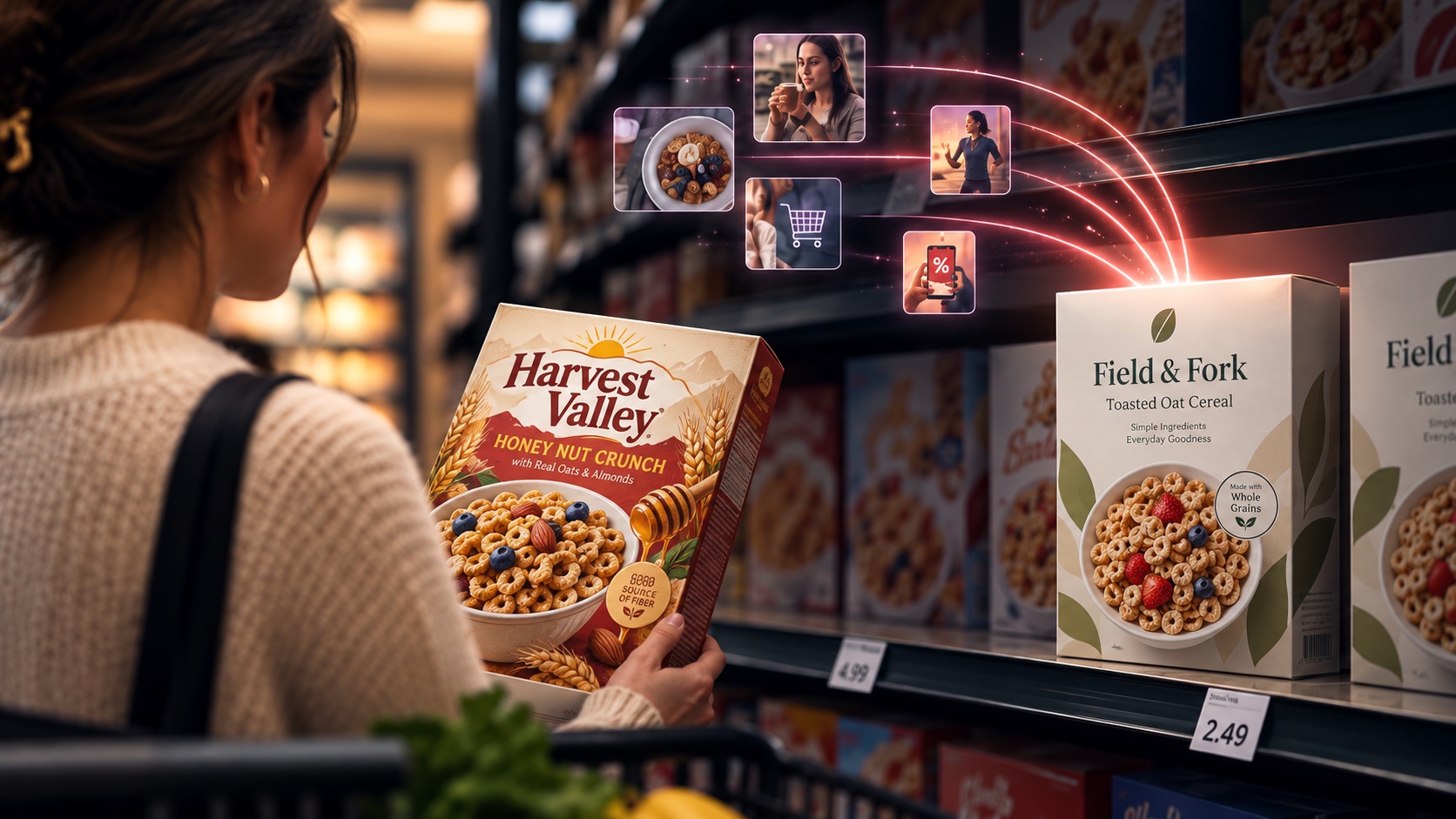
Look at what those numbers tell you. Retailers are not just stocking your product anymore. They are studying the consumer who buys it. They have the transaction, the loyalty card, the app, the receipt. They know what she bought last month and what she switched from. And now they are building products against that knowledge and putting them on the shelf next to you at a lower price.
That is the tension I have been watching for a few quarters now. The company that makes the product does not have the shelf. The company that has the shelf now makes a competing product. And only one of them knows the consumer.
I ask brands a simple question all the time. Your consumer bought you online, did she come back and buy you in store? I am surprised how many cannot answer it. Most of them do not know where she started, let alone where she went.
Three things you cannot see from a syndicated report
Every shelf brand I talk to has the same three blind spots. Let's break them down.
One. You can see what sold. You cannot see who bought it. Your own website is the first place you ever meet a buyer as a person, with an email and a history you can act on, and for most of you that is a rounding error on total units. Deloitte puts trade spend at 20 to 30 percent of gross sales in consumer products, the second biggest line after cost of goods. You are spending that every year, and you cannot name one person it reached.
Two. Your retailer data does not connect. Walmart and Kroger will often share more than top-line numbers, and that is great. But what Walmart hands you does not give you the same persistent consumer record as what Kroger hands you. Different formats, different identifiers, different rules about what leaves the building. Four retailers, four reports, and not one of them is about a person. You are running four small businesses and calling it one brand.
Three. You cannot tell trial from re-trial. Velocity jumps and you do not know if that is new buyers finding you or the same buyers coming back more often, right? Those are completely different problems with completely different fixes. Syndicated sales data cannot show you the same person buying again across retailers, so you guess, and if you guess wrong you spend a year fixing the wrong thing. All the while the private label sits next to you at a lower price, and the first time you learn your buyers drifted is the line review, six to nine months after it started.
Everything else is vanity
I am a big believer in ROI. Lift. Attributable gain. Flash is fine, but what did it actually change?
Here is why that matters for this problem. Most of what a shelf brand can measure about its consumer is activity. Units moved. Share of category. Facings held. Those tell you the product is being bought. They do not tell you whether anything you did caused it, or whether the same people are still with you. That is the same trap I watched marketers fall into when I ran an attribution business. A dashboard full of numbers that go up, and no way to say why.
It gets a hell of a lot harder to prove incrementality on a consumer you cannot see. You cannot separate what your program caused from what was going to happen anyway if you never knew who was in the program. So you end up with a busy program instead of an effective one, eating margin to incentivize behavior that was already going to happen. Those three blind spots are the reason you cannot prove your loyalty spend is working. They are also the reason the retailer can.
I will be straight about the hard part
Getting this data is not easy, and anyone who tells you otherwise is selling something.
Retailers are not going to hand over shopper-level records. QR codes on pack are a packaging project measured in quarters, not weeks. Receipt scanning asks the consumer to do something, and friction is an allergy. I have had smart people in this industry tell me it is too much to ask of a shopper.
I do not agree, but I understand the objection. The excuse is that it is hard. Hard can be solved. So let me be precise about what I am claiming. I am not saying you can know every buyer. I am saying you can know a meaningful and growing share of them, and today most shelf brands know close to none.
Meet the consumer where they actually are
Here is the part that gets me going. Every one of those retail transactions produces a receipt. Store, date, basket, your SKU, all on one piece of paper. It is the most complete record of the purchase the consumer can hand back to you, and today it goes in the trash.
Your consumer is not online reading your emails. She is at the register. Meet her there, and give her a reason to show you that receipt.
That is the whole mechanic. A reason on the pack, on the display, in the follow-up if you have one. A reward worth thirty seconds of her time. And an engine behind it that turns one receipt into a known consumer and a second receipt into a repeat purchase you can actually see. Clicks and bricks in one profile.
Once you know her, the blind spots close one by one. You can tell trial from re-trial because you can see the same person twice. You can join Walmart to Kroger because the consumer is the join key, not the retailer. And you can walk into a line review with your own view of your own buyers sitting next to the retailer's view. That is how you stop renting your consumer relationship from the retailer and start earning preference yourself.
Mark my words. Twelve months from now we look back at this, and the shelf brands that moved on it are the ones the retailer is still calling.
Two tests before Friday
Two tests. The best part is they require no budget.
Tonight, on the way home, stop at a Target and buy your own product. Then try to tell your own company you did it. Look at the pack. Look at the shelf. Look at the receipt. Is there anything, anywhere, that gives you a reason and a way to say "I just bought this" to the brand that made it? Time how long it takes you. For most shelf brands the answer is that there is no way to do it at all, and you just watched your best consumer walk out the door with your SKU in the bag and no way to say hello.
Monday morning, find whoever runs retail sales and ask three questions. How many units did we sell through Target last quarter? They will answer in about five seconds. How many of those buyers bought us the quarter before? Count the pause. Can you name one of them? Count the silence.
The length of that silence is your first-party data strategy right now.
I will bet you a coffee you fail both tests. And if I am a brand manager who just failed both tests, I am not waiting for the 2027 planning cycle. I am calling my CTO today. Not next quarter. Today.
If you want us to run the second test with you, say so in the comments and my team will reach out.
Sources
- Deloitte, trade promotion spend at 20 to 30 percent of gross sales for consumer products.
- Walmart, "Walmart Launches bettergoods," corporate press release, 30 April 2024. Sales and repeat figures from Walmart CFO John David Rainey at the Oppenheimer Consumer Growth and E-Commerce Conference, 9 June 2025, as reported by Food Business News (11 June 2025) and Grocery Dive (23 June 2025).
- Kroger, second quarter 2026 results, 11 September 2026. Identical sales and guidance per the Kroger press release and Reuters. Private Selection and Our Brands figures from CEO Greg Foran on the Q2 earnings call, as reported by Grocery Dive (14 September 2026).