AI Is Picking One Brand In Your Category. It Is Not Asking You.
By Jacek Materna, CEO, TrueLoyal | 6 min read | Part 1 of a series
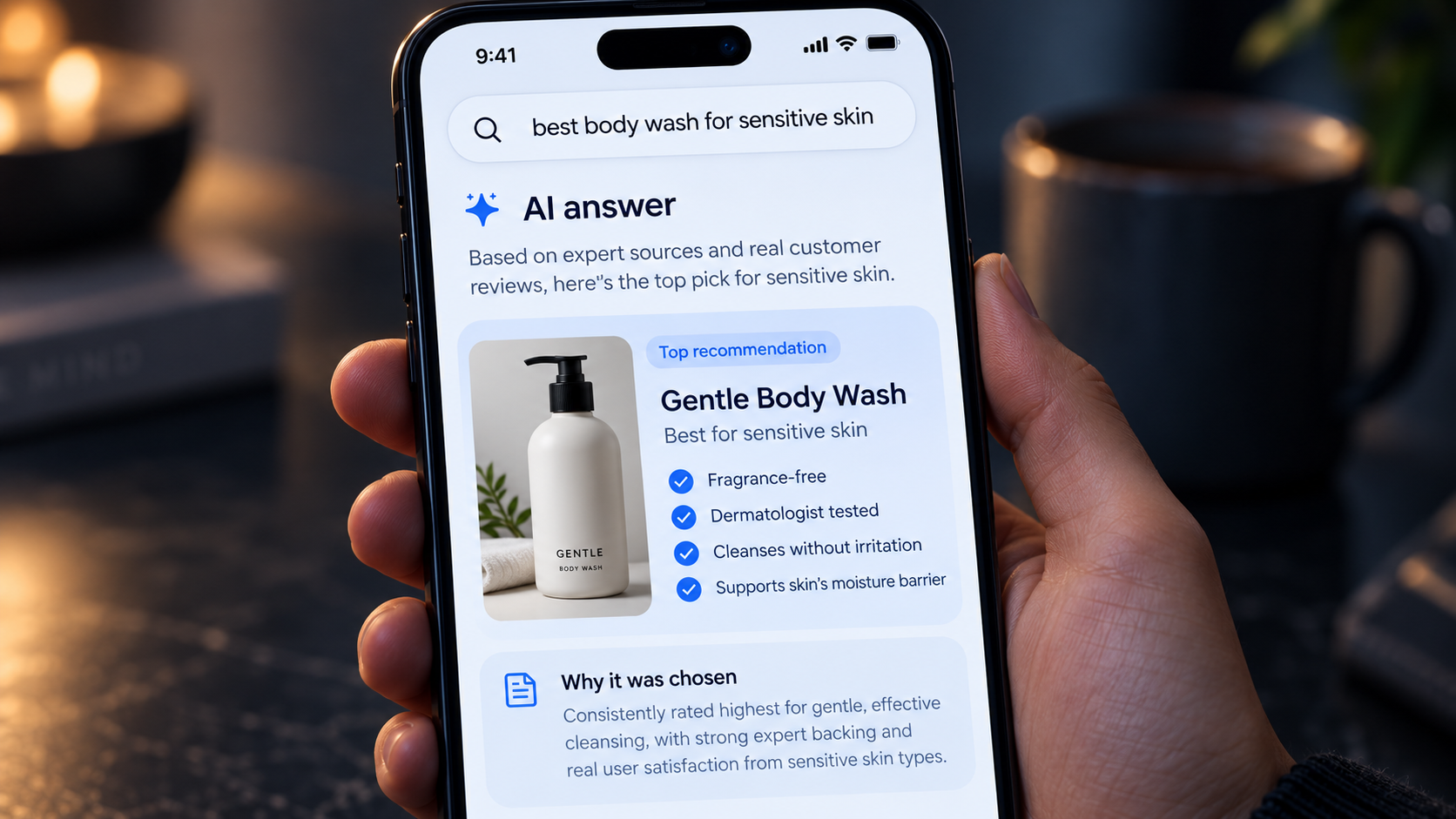
Someone opened their phone last night and typed “best body wash for sensitive skin.” They did not scroll. They read four sentences, picked the brand named first, and bought it.
No category page. No side by side. No ten blue links.
Here is the bottom line. In AI search there is no page one. There is one answer, and your category gets one winner.
For twenty five years the job was to be in the top ten. Rank fourth, get a slice. Rank seventh, get a smaller slice. The whole discipline was built on the idea that a losing position still paid something.
That floor is gone. When an assistant answers a question it pulls a handful of sources and names one or two brands. Everyone else is not ranked lower. They are absent.
There is no second place in a sentence.
Where does your brand land when a machine answers the question?
TrueLoyal helps consumer brands that sell online and on shelf capture the first-party consumer data the next era of discovery runs on.
The uncomfortable part
Most brands hear “AI has no brand affinity” and relax a little. It sounds like a level field.
It is not. AI has enormous affinity. Just not to you.
5WPR synthesized 680 million citations across ChatGPT, Claude, Gemini, Perplexity and Google AI Overviews. The top fifteen domains take 68% of all citation share, a concentration more extreme than PageRank ever produced. And the single most cited source across every major engine is Reddit, at roughly 40%.
Read that again. The system deciding your category winner is mostly reading what your consumers said about you somewhere you do not own.
- 68% of all AI citation share goes to just fifteen domains. More concentrated than PageRank ever was.
- 84% of AI citations trace back to earned media, not your owned content or your SEO pages.
- 6.5x more likely that a brand is discovered through third party sources than through its own domain.
Muck Rack looked at 25 million cited links and found 84% of AI citations come from earned media. AirOps found brands are 6.5 times more likely to be discovered through third party sources than through their own site.
The input is not your homepage. It is what your consumers said about you, in rooms your brand team has never been able to book.
Your SEO budget does not transfer
Here is where it gets expensive. Ahrefs ran 15,000 queries and found only 12% of the URLs AI tools cite also appear in Google’s top ten organic results. A separate study of 863,000 search pages put the overlap at 38%. Pick either number. Neither one is anywhere close to full carryover.
A decade of ranking work does not follow you across. A page can sit at position one on Google and never get cited once. A page with no ranking at all can anchor the answer.
Most CPG teams are still funding the old motion and reporting on the old dashboard, and the dashboard still looks fine. That is the dangerous part.
The other half of this shift is happening at checkout.
Max Savransky on what agentic commerce demands of a loyalty program, and why most were never built for a shopper who is not human.
And then the agents show up
Morgan Stanley puts 10 to 20% of US ecommerce as agent driven by 2030. J.P. Morgan says up to 25% of US online sales. Gartner says 20% of digital commerce transactions through AI platforms. Different houses, different numbers, same direction of travel.
I will be straight about where this actually is today. Agent checkout converts badly, roughly 86% worse than affiliate traffic, because storefronts were built for people. Around a quarter of consumers say they will never hand a purchase to an agent. This is early and it is messy, and I am not going to pretend otherwise.
But do not let the messy checkout hide the clean lesson. An agent shopping for someone works off a brief that person wrote before the shopping started. Price ceiling. Delivery window. Preferred brands. If your brand is not in that brief, no amount of creative reaches it. The agent is not looking at your banner. It is working a list.
Which moves the entire game upstream, to whether a consumer thought enough of you to name you before they ever started shopping.
If you sell on shelf, you have a second problem stacked on the first
Everything above is true for any brand. It is worse for the ones I spend most of my time with, the brands doing a slice of volume through their own site and the large majority through retailers and distributors.
You do not own the transaction. Someone buys your product at Target and you learn about it as a line on a syndicated report weeks later. You do not know who they are. You cannot email them. You cannot ask them for a review, a photo, or two sentences about why they switched from the brand they used before.
So the brand with the most volume in the category can end up with the least consumer voice attached to it. Your competitor doing a third of your revenue out of a Shopify store is producing more of the evidence a machine reads than you are. Not because they are better. Because they know who bought.
That is the shape of the problem. Not media spend. Not shelf position. Identity.
The way out is knowing who bought, wherever they bought it. Receipt scanning that turns an anonymous shelf purchase into a known consumer. A program worth registering for. A reason to come back and say something. All of it pointed at one consumer profile that does not care which channel the purchase happened in.
Once you know them, you can ask. Asking is how consumer voice gets made. And consumer voice is the raw material every one of these systems is assembled from.
You cannot ask a consumer you have never met.
Receipt scanning and rewards connect retail and distributor purchases to known consumers, so brands that sell online and on shelf can build first-party data from both.
So what do you actually do
The market response so far has been to buy AI visibility tooling and point it at your own website. Structured data, FAQ blocks, llms.txt, a GEO retainer. Do that work. It is the basics.
It will not win you a category.
You cannot optimize your way into an answer assembled mostly from what other people wrote. The only durable input is the volume and quality of real consumer voice about your product in the places machines read. Reviews. Communities. Forums. Q&A. Creator content. Coverage that exists because a consumer gave someone a reason to write it.
Call that what it is. A loyalty outcome.
This is a strange thing for a loyalty CEO to say out loud, so I will say it plainly. Loyalty was sold for twenty years as a retention tool. Keep the customer you already have. In an AI search world it quietly became an acquisition input, because the only way to be the brand the machine names is to have a large, active, vocal base of consumers producing the evidence it reads.
Your most engaged consumers are not just repeat buyers anymore. They are your distribution.
That is the whole reason we built for brands that sell online and on shelf rather than one or the other.
Start here this week
Take the five questions a consumer asks before buying in your category. Not your brand name, the category question. Run them through ChatGPT, Gemini and Perplexity. Write down who gets named.
If you are not in the answer, you have a discovery problem, not a media problem.
And if you are in the answer, go look at what it cited. I will bet you a coffee it is not your homepage.
Then go find out what percentage of last quarter’s units you can tie to a consumer you could actually contact. That number is the ceiling on everything above.
I am spending the next run of episodes on this
The Loyalty Recap is my series on LinkedIn. A few minutes an episode, real brands, real numbers, no deck voice. The next stretch goes deep on where discovery is moving, what it does to brands selling through retailers, and what loyalty is actually for when the shelf is a sentence.
Follow along if this one is keeping you up too.
Follow The Loyalty Recap
My series on LinkedIn. Real brands, real numbers, five minutes or less.
Loyalty for consumer brands that sell online and on shelf.
Schedule a demo and we’ll show your Loyalty ROI in 45 minutes or less.
Author
Jacek Materna is the CEO of TrueLoyal and the host of The Loyalty Recap. He writes about loyalty, CPG, and what happens to consumer brands when the shelf stops being a shelf. Connect with him on LinkedIn.
Sources
- 5WPR, AI Platform Citation Source Index 2026 (May 2026). Synthesis of 680M citations across six citation studies, Aug 2024 to Apr 2026. Top 15 domains at 68% of citation share; Reddit most cited across engines at roughly 40%.
- Muck Rack, AI Citation Study 2026. 25M cited links across ChatGPT, Claude and Gemini; 84% of citations trace to earned media.
- AirOps research on AI search discovery, 2026. Brands 6.5x more likely to be discovered via third party sources than owned domains.
- Ahrefs analysis of 15,000 queries, 2026. 12% overlap between AI-cited URLs and Google top-10 organic results. Compare: Digital Applied 863K-SERP study (March 2026) put overlap at 38%.
- Morgan Stanley (10 to 20% of US ecommerce agent driven by 2030), J.P. Morgan (up to 25% of US online sales), Gartner (20% of digital commerce transactions via AI platforms by 2030). Compiled in commercetools, Agentic Commerce Stats 2026.
- Agent conversion and consumer trust figures, 2026 agentic commerce market analyses. Agent traffic converting roughly 86% worse than affiliate; 27% of consumers trust no organization to run an AI shopping agent, 24% say they will never delegate purchases.