Empower Your Customers To Tell Their Story

One of the things that I often say in my content marketing workshops is “if you want to tell a story, put a person in it.” So often, and especially among marketers, the tendency is to want to tell the story of a brand, or a product – and not the people who actually consume the brand or the product.
Putting people – and especially your customers – at the center of your storytelling and content marketing process will be one of the single most impactful things you can do.
So, why is it so hard for us to let our customers do the storytelling. Research tells us that this can be powerful. For example, Ads generated by customer stories typically get a 4X higher click through rate. Brand engagement increases an average of 28% when customers are exposed to a combination of user created product videos and professional content.

So, what is the challenge? Well it turns out that we don't actually have a good process for assembling these stories.
A Process For Customer Content And Telling Stories
The irony of most content marketing operations is that there is little strategy and process integrated before the team just begins “creating content”. This is especially true when we're letting customers tell the story. We simply think that we should be reactive to reviews, or social posts etc.. instead of actually figuring out a strong narrative and putting that into a strategic editorial calendar.
In other words – we only react to all user generated content. A new social channel like Facebook appears, and the business decides that it needs a Facebook strategy and/or team. Or, mobile technologies become the way that our customers want to engage with content, so the strategy question becomes “how do we transform all the content we're doing into a mobile interface?”

These are simply the wrong questions. In order for any enterprise to scale the number of content-driven experiences it ultimately manages, it is incredibly important to understand “why” and “what” customer content should exist in the first place. And then, and only then, the business will need to understand “how” it can use, re-use, package, re-package and manage customer content on ANY channel that may be developed.
Developing a process to manage the creation and management of individual “owned media” efforts (content hubs, web sites, email, and even the interactive signage and kiosks…) is probably the most critical piece of what a customer content process is meant to achieve.
A Content Marketing Operation Team will, of course, have the charter to manage existing owned content-driven experiences such as blogs, websites, print magazines, etc… But the additional responsibility will be to acquire new customer content or to figure out how to infuse this content into the overall storytelling engine.
In my last book, Experiences: The 7th Era of Marketing, we told the story of the American Express OPEN forum, the extremely popular educational community for owners looking for expert advice on managing their business.
Mary Ann Fitzmaurice Reilly, senior vice president, American Express OPEN, described the model like this:
“…it takes a small army, both internal and external,” offered Mary Ann, who mentioned a litany of external partners who help with site development, article content, online media, and related live events. When discussing why AmEx sought outside help like Federated Media for bloggers, Mary Ann pointed out that, “You can't do it alone, there are a lot of experts—leverage them to make the most robust solution you can.”
Determining the right model and partner to build and manage a sustainable owned media customer content property will take the collective team's efforts. But then, once the group approves that effort – and any partner is selected - the management process will be critical to executing that initiative successfully.
Map The Experiences Of Customer Content Operations

The first step in determining whether any initiative is worth doing (or worth continuing) is to create an executional map, both from an editorial and a project-mapping perspective. The goal of this process is to create a high-level editorial and creative strategy—as well as to define the business goals and measurement—that will justify the existence of a given platform.
Put in its simplest terms, once an initiative has gone beyond the “this seems like a good idea” stage, the group actually has to determine what it will take to make it real.
To accomplish this, we have lately seen methodologies such as Agile take hold within businesses (especially within marketing groups) and pay some of the biggest dividends for this kind of work. Other methodologies (e.g., the “Lean Startup” by Eric Ries, “Radical Management” by Stephen Denning, and “Discovery Driven Growth” by Rita McGunther McGrath) have also created tremendous opportunities – and I would certainly encourage a deeper exploration of all of these approaches.
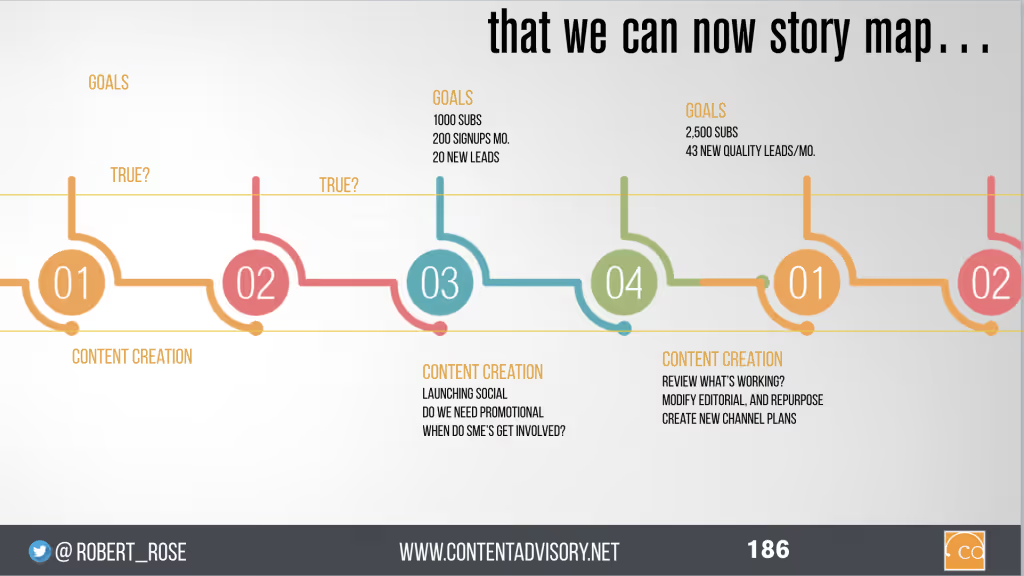
My specific approach is one that my co-author Carla Johnson and I talk about in Experiences: The 7th Era of Marketing called Story Mapping. This very specific methodology is both a template and an operational model to reach two distinct goals. The first goal of the Story Mapping process is how to create an editorial and creative strategy that helps to align the larger story with the brand approach.
[embed]https://www.slideshare.net/BigBlueMoose/storymapping-template[/embed]
Ultimately, the Story Map not only helps to align the business goals, it helps to align the purpose of the editorial and the creative as a means to create a compelling customer content-driven experience. Unlike a marketing campaign, the team is building a plan for something that is meant to last for a long time.
Build The Customer Content Experience And Its Purpose
As I mentioned earlier, we often create these customer voice hubs by reacting, and “waiting” for customers to actually say something. And one of the troubles with that is that someone says “well, we won't know how good it is until customers start talking”. This isn't true. Deploying a smart map—and a process for managing your progress—should give you immediate indication of how you are progressing toward a goal and the ability to course correct along the way. And, assuming you have the right technology and process implemented, you can “bank” customer stories and assemble them in a proactive manner across your experiences.
Once you have a plan in place, the content marketing operation team also may be responsible for managing the ongoing development and execution of your platforms. Referring to the goals and timelines that you established within the initial mapping process will give the team a projection of what “success” should look like at this relative point in time. Then, in order to achieve “success,” the content marketing operation team will need to always be looking to “where we are,” and then make assumptions about “what needs to be true” at various waypoints along the path.
But, how will you know if you are tracking successfully? What will be the primary indicators of whether this initiative should remain a piece of your experience portfolio? This is the process of building and managing customer driven stories.

Your Customers Will Tell Your Story
Success may simply be about executing exactly as planned. Or, as is most often the case, it may mean improvising based on a sudden, unplanned challenge or obstacle (yes, sometimes customers will say inaccurate or not very nice things). One of the keys that we think is critical, is how to get into a review cycle that is not based on major developmental milestones – but rather as a function of progress toward the different phases of the story as the team has mapped it. Exactly how granular you make these rhythmic review cycles will depend largely on how confident you are about the assumptions you've made.
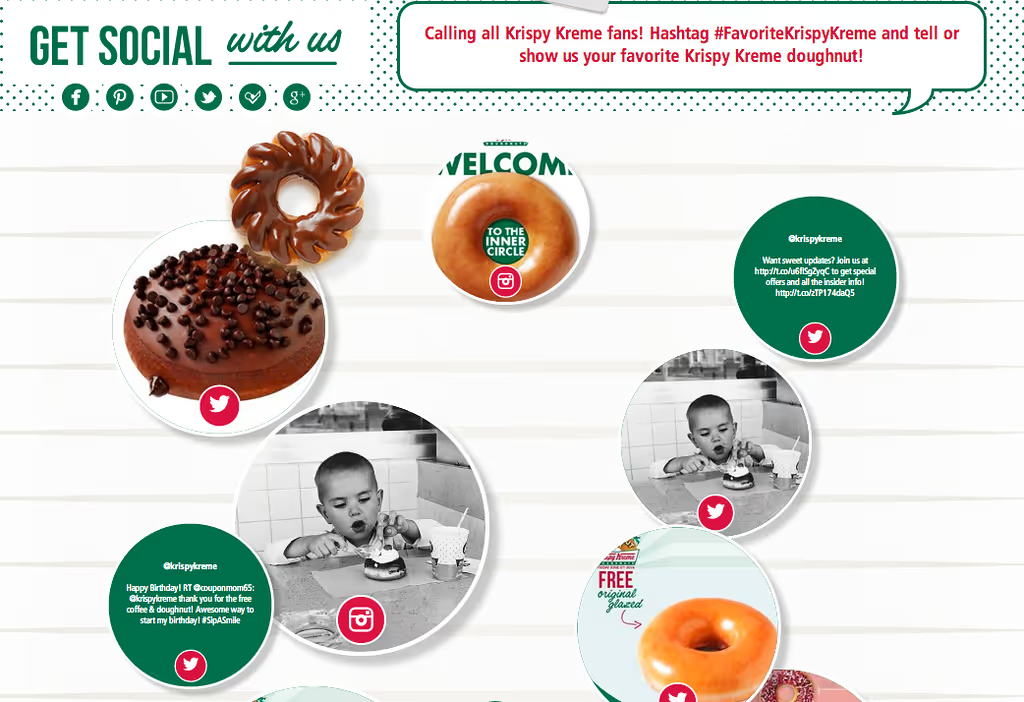
Krispy Kreme using TrueLoyal to display Customer Stories on their homepage.
It's often said that you can't “control” the customer's story. This may be true. But, you can orchestrate and lead it. Leading your customers is core to differentiating, and is what separates a great story from a poor one.
Whatever your approach – realize that all great stories are told with forethought and a great process. You can let your customers tell the story you want, and more importantly you can empower them to tell theirs.