CAC Attack: When Your Loyalty Program Members Become Your Best Salespeople
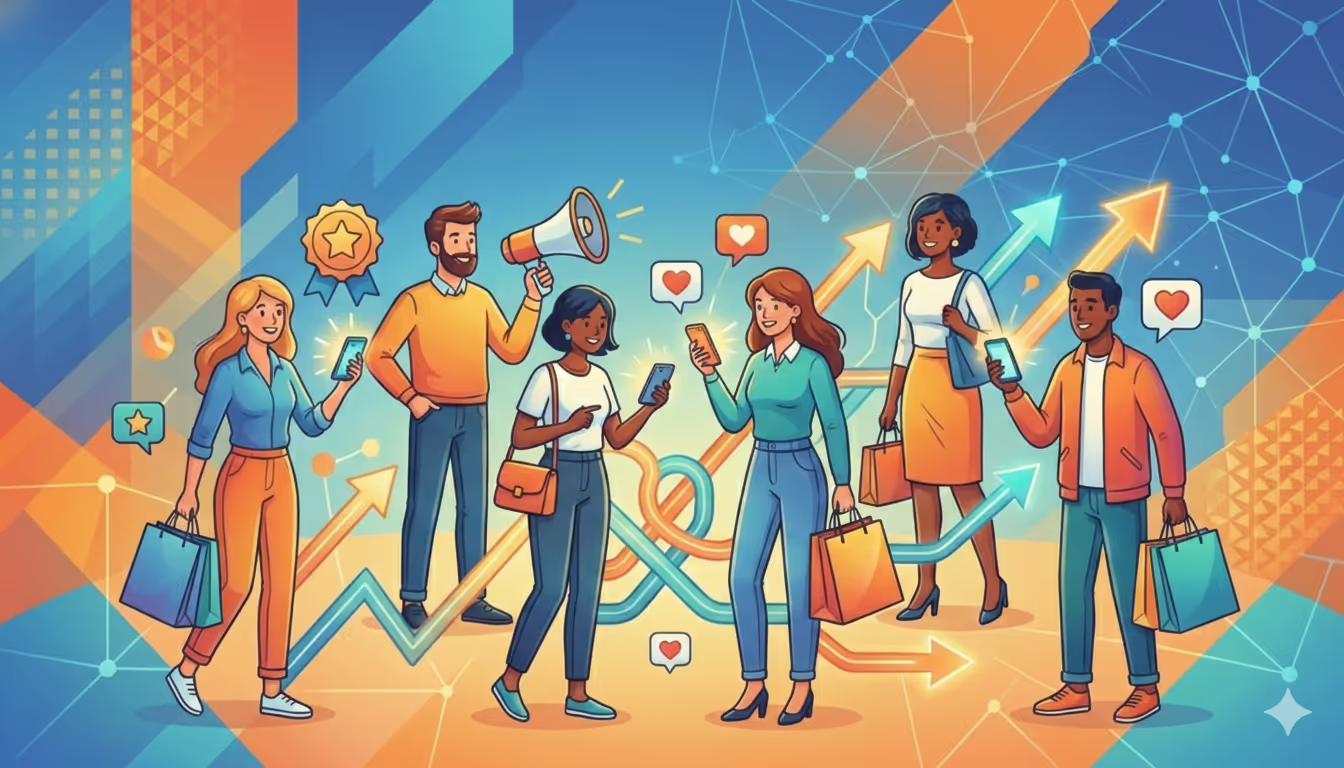
Despite loyalty programs being primarily a retention tool, they don’t have to be. When structured correctly, they're one of the most powerful CAC reduction engines available. In a previous blog article, I wrote about Loyalty ROI and briefly referenced that a brand’s cost to acquire customers (CAC) can be directly and positively impacted by a loyalty program. In this blog, I take a deeper dive into the how.
Identifying The CAC Problem
One of the most common challenges I consistently hear from brands is that customers are lost after the first purchase. The percentage of lost customers varies by industry and by brand, but unless something is done, the problem remains.
Let’s imagine a brand is spending $40 to acquire a customer who spends $60 once and never returns. When considering that a healthy CAC to AOV ratio should be in the region of about 1:3, that means the expectation on return is generally around $120. If that isn’t spent on the first transaction, then it should be made up via repeat purchase behaviour. And so, if the customer spends $60 and then churns, the result is suboptimal.
This is where most brands find themselves trapped. They're stuck on what is effectively an acquisition treadmill: spending more each quarter just to maintain the same growth rate, watching margins erode, and hoping something changes.
How Loyalty Programs Reduce CAC
The value engine of a loyalty program breaks this cycle by attacking CAC from multiple angles at once. It increases customer lifetime value, which improves unit economics. That means the same $40 CAC might now equate to $140 across two visits. It drives referrals and word-of-mouth, which lowers blended CAC. Plus, it can create predictable revenue streams, which means brands can afford to be more strategic about when and how they acquire new customers.
Therefore, loyalty programs should be transforming your customer base into a compounding asset rather than a depreciating one.
Under this model, advocacy becomes an acquisition driver. When customers are invested in your program, they don't just buy more. They become stickier, engage with the brand more and will tell others. Word-of-mouth referrals have a fundamentally lower CAC than paid channels, often quite significantly. Research from Wharton Business School found that referred customers cost $23 less to acquire and deliver 16% higher lifetime value.
Many brands also miss developing a strategy that primarily targets their most valuable members to drive referrals. These are the members who will be the most likely to advocate for your brand. Coming up with ways in which to leverage them in the right way will absolutely be worth it.
Retention remains a value multiplier. A 5% increase in retention can increase profits by 25% to 95%, according to Bain & Company. Through a CAC lens, this isn't just about keeping customers longer, it's about fundamentally changing the ROI calculation on every dollar spent to acquire them. When a brand’s average customer sticks around for three years instead of one, that brand can afford to spend three times as much to acquire them, or maintain the same spend where possible and bank the increase in margin.
Data also enables more precision. As discussed in the Loyalty ROI blog, loyalty programs are excellent data collection engines across both zero-party and first-party data. This can make a brand’s acquisition spend dramatically more efficient. Instead of broad targeting that wastes budget on unqualified prospects, the brand can identify and acquire customers who look like your best members. This is why focusing on CLV and properly understanding your best members can pay huge dividends.
How Best in Class Programs Approach CAC
Starbucks Rewards has become one of the most successful examples of using loyalty to reduce acquisition costs. With 33.8 million active members in the United States as of Q4 2024, the program generates significant revenue, but the real value is in how it's changed Starbucks' growth model. Loyalty members are 5.6 times more likely to visit Starbucks daily compared to non-members and members contribute 57% of U.S. sales.
The interesting part is the program's personalization capabilities have helped reduce overall marketing costs while driving frequency. The app's mobile ordering functionality creates a frictionless experience that helps encourage daily habits, and those habits turn customers into advocates. Personalized offers drive frequency, the app creates convenience that becomes habitual, and members naturally recommend the program to friends because of said convenience and experience. It should be noted that as Starbucks has recently moved to a tiered model, a lot of what I’ve noted about Sephora should also apply.
Sephora's Beauty Insider program demonstrates how loyalty can become your primary acquisition strategy. With 34 million members globally, who drive 80% of transactions, the program has fundamentally changed how Sephora grows.
The three-tiered structure creates aspiration that supports behavioural change. Members must increase their spending to reach the next tier, which helps boost lifetime value and makes the initial acquisition investment more efficient. However, the real CAC impact comes from how Sephora built a community around the program. The Beauty Insider Community turned members into content creators, problem-solvers, and brand advocates.
This community-driven approach generates organic reach that paid advertising simply can't match. Members share reviews, post beauty tips, and recommend products, which creates a flywheel of user-generated content that attracts new members at a cost that’s almost negligible. This approach has helped Sephora achieve a 22% increase in cross-sell and up to 51% increase in upsell revenue from program members.
The program succeeds precisely because Sephora recognized that in beauty, community is currency. By making the Beauty Insider program about connection and expertise, rather than just discounts, they created something worth talking about. And when your members become your marketers, the impact to your CAC can be transformative.
Structuring For Positive CAC Impact
There’s a cautionary tale, too. Poorly designed programs can increase CAC by training customers to wait for discounts. This destroys margins and is regrettably extremely common. The difference comes down to how brands structure the program from day one.
Loyalty is earned. To earn it, brands must do their part. That means thinking about the entire customer experience, convenience, relevance, the whole nine yards. Doing so will ensure advocacy isn’t just the north star, it’s a realistic outcome. Referral mechanics can be directly embedded into the program design. Make it easy and rewarding for members to bring others in. The key is converting paid traffic into long-term members rather than one-time buyers, which fundamentally changes the brand’s commercials.
Where appropriate, use tiers to drive the right behaviors. Tiered programs create goal gradients, where the closer members get to the next tier, the faster they strive to reach it. This increases lifetime value quicker, which improves payback periods on acquisition spend. Additionally, if tier benefits have been designed well, then the associated status becomes something worth sharing. This helps drive organic acquisition.
Continue to invest in the member experience and be sure to undertake regular CX and program audits. The right experiences will create moments worth sharing with others, which in turn will create loyalty.
Summary
Spending more on acquisition to maintain growth doesn't work when CAC keeps rising and effectiveness keeps falling. Loyalty programs offer a fundamentally different path, by turning a brand’s existing customer base into their most efficient acquisition channel.
The brands winning aren't treating loyalty as a campaign or a pure retention play. They are using it to rewrite their entire growth equation. They're building programs that drive advocacy, generate referrals, create network effects, and ultimately reduce the cost of acquiring every new customer. If CAC goes down and LTV goes up, brands don't just improve margins, they create a sustained, defensible, compounding advantage. This is something that any CFO will truly get behind.
The question isn't whether loyalty programs can reduce CAC. The question is whether you're willing to structure your program to do it. So, stop buying customers and start building advocates.
_________________________________________________________________________________
Max Savransky is the Global Director of Loyalty Strategy at TrueLoyal. Max is a customer strategy, loyalty and data leader, with a proven 17-year track record of designing, validating and deploying successful client strategies to drive engagement, retention and revenue growth. Max is also one of the co-authors of ‘Loyalty Programs The Complete Guide’ (editions 1 and 2), the definitive book on loyalty for industry professionals.
Connect with me on LinkedIn!
_________________________________________________________
Want to stop burning money on acquisition and start building a loyalty value engine that pays for itself? TrueLoyal helps brands design programs that reduce CAC while driving sustainable growth.
If you'd like to chat about how we can help, get in touch with our Enterprise Sales team.