Loyalty ROI: Return on Investment or Reporting Over Impact?
Loyalty ROI is notoriously hard to measure. Most brands think they know what Loyalty ROI is - “did this program pay for itself?” - but that question alone blindsides more loyalty investments than almost anything else. This blog aims to help cut through the noise and define what Loyalty ROI is, how to best understand it and how to structure it.
Defining Loyalty ROI
Loyalty ROI isn’t a single number that’s plugged into a spreadsheet and defended. Instead, it’s a more of a lens through which you decide whether your loyalty program is helping the business grow better.
I like to think of it like this: loyalty ROI applies to many business metrics. It is not the entire solution, it’s not the panacea, but rather, a way to help improve a number of key business metrics in a positive way. Effectively, it’s a value engine, contributing to a brand’s success.
For CFOs and other key C-suite stakeholders, this mindset is what separates a program that could be a cost centre from one that becomes a strategic value engine.
The formula for ROI can be simple, where ROI = (Gain – Cost) / Cost × 100. That’s fine for a campaign.
But a loyalty program isn’t a campaign and shouldn’t be treated as such. It’s a value engine that helps build customer relationships over the long term. If you only look at revenue this year versus cost this year, you’re basically judging how successful a relationship will be by the first date.
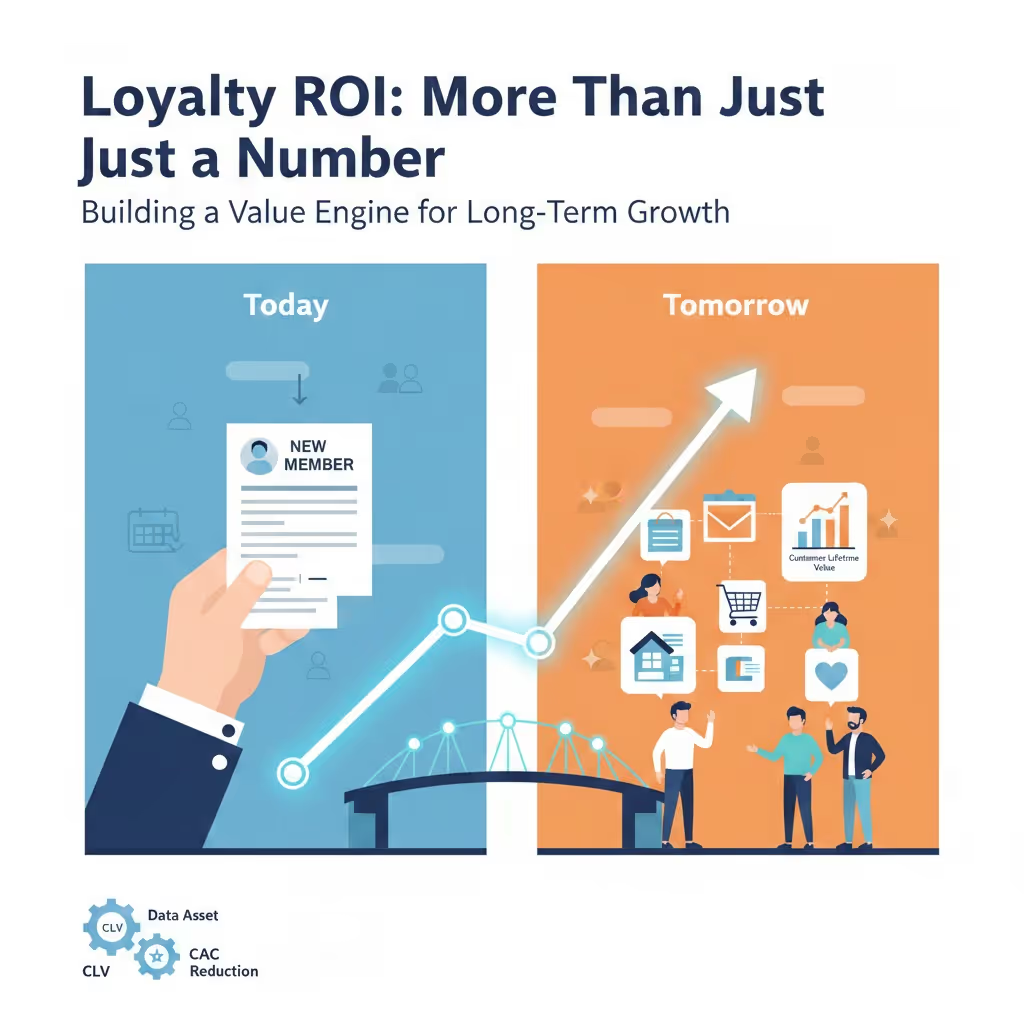
Loyalty ROI accounts for the creation of future value, such as more repeat behaviour over time, deeper engagement with the brand, a reduction in customer acquisition cost (CAC), improvements in customer lifetime value (CLV) and the consistent building of the customer data asset. It’s a mix of short-term cash flows and long-term stickiness and behavioural shifts.
Brands need to be measuring what loyalty changes, not just what it contributes.
Understanding Loyalty ROI
The cost part, per the above formula can be simple: determine the costs of the platform, rewards, operational resources and marketing. Relatively easy to tally.
Now let’s consider the gain part. Again, the relatively easy measurables are incremental sales, repeat purchases by a greater cohort of members, improvement in retention, and if executed correctly, better margin uplifts.
But there’s more gain, and this is where numerous brands don’t stay the course because the shorter-term thinking outweighs the longer-term outcomes.
Consider improvements to CLV, which is a longer-term metric. Will the loyalty program be the only contributor? Of course not. But if structured correctly, it will absolutely have a contributing impact.
Will the loyalty program have a positive impact on CAC? It will, because your cost to acquire customers can be directly and positively impacted by having your most valuable customers advocate for your brand. People feed off positive, transparent reviews and referrals and there’s nothing like a happy customer.
The unredeemed value of loyalty currencies is another longer-term positive impact to the balance sheet. Granted, breakage should be minimized because it’s an engagement killer. Nevertheless, it’s a foregone conclusion that breakage will exist; but it should be recognized as revenue generated by the loyalty program.
One of the most underutilised areas is the building of the customer data asset via the loyalty program. This is a missed opportunity for many brands.
The first missed opportunity is usually not collecting and/or utilising the data available via first party and zero party data sources and approaches in the right way. The second missed opportunity is not going deeper into zero party data collection and gaining insight into areas such as intent, decision drivers and areas of friction.
When brands collect zero party data via a robust and structured approach, consider that the collected data can hold significant value and impact marketing, predictive, operational, behavioural and commercial areas. The question brands need to ask is – how much is this data worth to them and how can they use it to transform their business operations and customer approach?
Structuring Loyalty ROI
1) Always start with a baseline.
What would revenue and customer behaviour have looked like without loyalty? That’s the counterfactual. It’s the only meaningful way to isolate what loyalty has actually changed.
2) Consider behaviors, not just numbers.
Incremental revenue and spend are important, but so are shifts in retention curves, repurchase rates, and CAC. These behavioural signals often matter more than raw dollars in the first year of program operation.
3) Layer in LTV.
Incremental revenue this year is nice. Increasing a customer’s lifetime value is where loyalty earns its stripes. If your members stick around longer and spend more over time, that ramps your allowable CAC and unlocks growth investment.
Imagine your loyalty program like a gym membership. If you launched a gym and only measured revenue from new signups this month, you’d miss half the story: you want to ensure members come back, use more services and to advocate for you.
Loyalty programs are no different. The initial revenue bump is useful, but longer-term stickiness is where the real opportunity is. CAC goes down, LTV goes up, and suddenly your loyalty value engine pays dividends in ways that deferred accounting alone can’t capture.
Summary
Loyalty ROI is an outcome of a series of decisions. Treating Loyalty ROI as a range informed by multiple metrics, rather than a single point to defend is the best way to look at it. When finance stops asking for continued justification and starts asking how to double down on the strategy being executed, you’ll know you’re on the right track.
And so, whether you believe ROI should mean Reporting Over Impact, Return Over Illusion, Revenue Over Incentives, or perhaps something else entirely, the message is this: true Loyalty ROI should bridge today with tomorrow. It should tell a story about how your program changes customer behaviour, improves CAC and LTV, and enables smarter business decisions.
When you get those pieces of the puzzle right, loyalty stops being a campaign or an afterthought and becomes a value engine that makes every dollar work harder for your brand.
__________________________________________________________________________________
Max Savransky is the Global Director of Loyalty Strategy at TrueLoyal. Max is a customer strategy, loyalty and data leader, with a proven 17-year track record of designing, validating and deploying successful client strategies to drive engagement, retention and revenue growth. Max is also one of the co-authors of ‘Loyalty Programs The Complete Guide’ (editions 1 and 2), the definitive book on loyalty for industry professionals.
Connect with me on LinkedIn!
__________________________________________________________________________________
Want to stop guessing and start testing? TrueLoyal helps brands figure out where to start and how to enable the right business outcomes.
If you’d like to chat about how we can help, get in touch with our Enterprise Sales team.