How #Hashtags Changed the Way we Talk
“For a generation especially interested in brevity, that's a pretty cool way to talk.”
-Lauren Schuhmacher, Huffington Post
There's a story about hashtags and how they're changing our speech patterns. It goes something like this:
The hashtag arose in 2007 as a way to categorize and “tag” tweets. It slowly gained traction, until 2009 or ‘10 when suddenly hashtags (and their users) went rogue. These errant tweeters took hashtags from their good and purposeful tagging function, and changed them into something terrible – a form of parenthetical commentary on the rest of the tweet.
For example:
The narrative doesn't end there of course: Hashtags escaped twitter, and spread, like a plague, to Facebook (“they don't even use hashtags” irate bloggers complained, until Facebook adjusted), to Instagram (#dog #ihaveadog #hat #thisismyhat #thisismydoginmyhat #followmeplease #Sunday #aghhhh), to everyday speech, where it is now acceptable to say (say!) things like “I love you guys! Hashtag blessed!”
“The colloquial hashtag has burst out of its use as a sorting tool and become a linguistic tumor – a tic more irritating than any banal link or lazy image meme,” declared Sam Biddle in his oft-referenced Gizmodo article: How the Hashtag is Ruining the English Language.
Yup. The hashtag is a LINGUISTIC TUMOR.
The tweet that invented the hashtag:
Sometimes I agree with this version of events. I'll hear someone drop a hashtag into daily conversation in an ironic but not-so-ironic way, and I'll think, hashtags are ruining the English language.
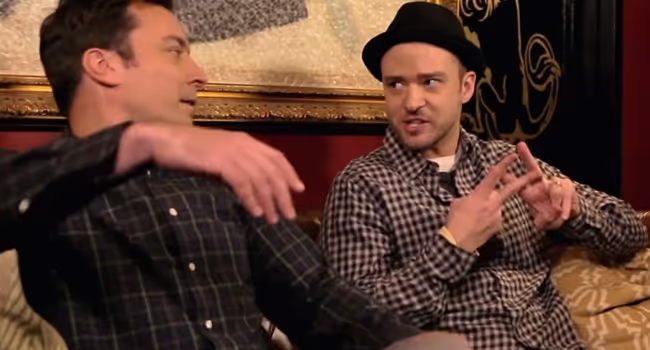
In case you have no idea what I'm talking about, stop reading this right now and watch this video of Justin Timberlake and Jimmy Fallon speaking with hashtags:
[embed width="650" height="400"]https://www.youtube.com/watch?v=57dzaMaouXA[/embed]
See? Please don't ever say “Hashtag: Blessed.”
It's terrible.
But after a little research about language and hashtags, I don't think they're destroying the English language.
And neither do linguists, who seem delighted by hashtags and their mission creep away from tagging and into conversation. In fact, a number of linguists see Twitter's fast-paced environment as a microcosm where they can study language trends that often parallel language trends offline. Not one linguist has called hashtags a tumor. So far.
So if they're not a tumor, what are they? Here's what I found:
1. Hashtags are “Paralanguage”
Paralanguage is something you already use, every day. It's the non-verbal cues that accompany speech and help us express meaning and tone - shoulder shrugs, intonation, facial expressions. But in the world of text, it is difficult to communicate those non-verbal ideas – like sarcasm or self-mockery. Its part of the reason that “JK” and “LOL” are so heavily used. Emoticons do their fair share of substituting as paralanguage as well. But hashtags expanded that ability drastically.
Now we could do sarcasm and self-deprecation.
“Among Twitter's triumphs is the reinvention of self-mockery.”
So says linguist Ben Zimmer, who argues in the Boston Globe that hashtags have given us a “sly new way” to undermine what we say. When we complain about tangled headphones and append “#firstworldproblems, it shows we know our own complaints are ridiculous. Zimmer tells the story of the spread of the hashtag from tag to tic very differently than Biddle:
“Suddenly, a humble indexing tool became a sophisticated new technique for self-deprecation in type.”
Hashtags aren't a tumor – they're a sophisticated new technique. They help us add a much-needed tonal layer to our communications.
2. Hashtags are our Greek Chorus
“THE SPOKEN HASHTAG is part of a general trend—one rarely treated as a scourge, generally barely perceived, and actually a sign of the zeitgeist.” -McWhorter, New Republic, 2012
In 2012, when spoken hashtags were first ‘causin a ruckus, New Republic published an article that claimed the hashtags were a sign of our modern times – part of a recent trend to see ourselves in the third person, to frame ourselves as performers, view ourselves from an ironic distance. Saying “Hashtag happy” elicits a mental picture of the speaker viewed from a distance, labeled with the word happy.
McWhorter claims that this perspective would have been impossible before movies and television began to deeply permeate modern life.
In this framework, Hashtags are a way of distancing ourselves from our own words – commentary on what we've just said or experienced. But is that really a sign of the zeitgeist? Gabe Doyle, a linguist at Stanford, makes the same point about tweets as meta-commentary, but he compares hashtags to the narrator of a book and a chorus in a Greek play. He calls it a shift in viewpoint from first person to third person.
And put that way, it doesn't seem like the sign of our times that the New Republic article makes it out to be. Forget television – hashtags are serving as a very ancient literary device.
3. Hashtags were always meant to mimic speech
Whatever the New Republic article gets wrong about television and 3rd person narration, it makes some fascinating points about the evolution from formal speaking and writing into informal speaking and writing. Essentially, McWhorter suggests that we aren't speaking the way we write when we say “hashtag” - instead hashtags already represented the way we speak.
“In their brevity, their tendency toward the spontaneous, their subjectivity, and often their pungency, texting and Twitter are a lot like speech—and in fact, are only writing in the technical sense.” McWhorter's version of events says that back in the day we had formal speaking as a way to tie the two worlds – of formal writing and informal speech – together. We made children memorize the Gettysburg address in school. Before that (way before that) Homer chanted the Odyssey from memory and only later wrote it down.
A simplified version of this viewpoint might be this – the written word and the spoken word have always influenced each other in their formality. In the past we spoke more formally because of how formally we wrote. In the present, we write less formally because of how informally we speak. Speech and writing influence each other, and always have.
This idea is supported by science. In a recent paper, six computer scientists from Brazil found “not only qualitative, but also quantitative similarities between offline and online speech communities.” In other words, the way language trends develop and words become popular IRL (in real life) is mimicked on Twitter. We really are writing how we talk.
What does this mean for language?
Linguists are pretty much divided. Some say verbal hashtags are a passing fad. Others don't. Anne Curzan, a linguist who specializes in the history of the English language, points to Benjamin Franklin's dislike of the verbs colonize and notice, comparing it to modern objections to LOL or using “friend” as a verb.
As if to prove that new internet-words will someday be as inoffensive as “notice,” the Oxford English Dictionary added “TL;DR” (short for Too Long; Didn't Read) to the dictionary in 2013 – at least in their online version.
In a recent Mashable article, Linguist Gerard Van Herk argues that internet speak has made us smarter:
"Today's youth are much more aware of the social and stylistic uses and meanings of different genres and language types, and are able to discuss them using metalinguistic terms like meme," he writes.
Yeah. That's right. We're the generation that uses METALINGUISTIC TERMs in everyday speech. Feel brilliant yet? Good.
What does this mean for Social Media?
If you're trying to create a hashtag that will stick, there is at least one lesson we can take from the linguists:
Hashtags that straddle its multiple uses (tagging and paralanguage, narrative and the informality of speech) are most likely to be successful.
The fairly funny Facebook satire group “Condescending Corporate Brand Page” mocks bad social media marketing efforts from corporations. They like to point out when companies fall prey to creating the #corporatehashtagthatnoonewilluseever. For example, asking consumers to tag posts of their Halloween costumes with #spookysavers.
Nope.
A common failure with these hashtags? They often only use the tagging function of hashtags - not the metacommentary function, or the paralanguage function. There is an easy litmus test to avoid creating the #corporatehashtagthatnoonewilluseever. Ask yourself: Would you say it in daily speech? Would Justin Timberlake?
The answer should be yes.